
Why Do We Keep Circling?
What lives beneath the surface emotions
I found myself feeling impatient on a call last week.
A circle of women I genuinely respect — intelligent, self-aware, doing real work on themselves and in the world. And the conversation came around to patterns, habitual ways of being, old loops.
I said something. Gently, but I said it. Why do we keep circling when we have the tools to come back to center?
The answer came quickly: stuff happens.
Yes. Of course it does. But we know that. We have awareness, we have practices, we have years of inner work between us. And still — we circle.
I sat with my impatience after the call. Turned it over. I suspected there was more here for me than what was apparent. Wondered briefly if I was being arrogant — expecting others to be further along than they are, or further along than I actually am myself. I don’t think it was arrogance. But I held the question honestly for a while, because that’s the work.
Here’s what I landed on: circling isn’t failure or just practice in returning to center. It’s an opportunity to go deeper, to witness, to be with, to allow, to resolve. It can be what happens when something pulls us off center and rather than shuffling away from it (sure to surface again later) we choose to be with it.
And then, as things generally do, I was handed my own experience of it.
Old grief surfaced. Not gently.
Someone who was the world to me once — someone I loved with the particular intensity you reserve for the people who shape you — left a wound that I thought I’d worked through, enough. I’d done work around the pain, enough. The anger, enough. I’d come to terms with it, or so I believed. Yet it was clear, something remained.
My chiropractor noticed heart energy congestion this week — before I’d named any of this consciously. Two days later I woke up with the old wound right in my face.
As I sat with it, I went below the pain and anger. Beneath the familiar story. And there it was — grief. Pure and old and patient. Waiting.
What I hadn’t done was grieve.
There’s a difference. Pain and anger are charging emotions — they keep you moving, defending, surviving. Grief is quieter and deeper and asks you to actually feel the loss. The love that had nowhere to go. The version of the relationship that never was and now never will be.
In my first book Calmly Centered I write about emotions and what lives beneath them — including this: the degree of the grief is equal to the degree of the love. And that loss needs to be honored, not managed.
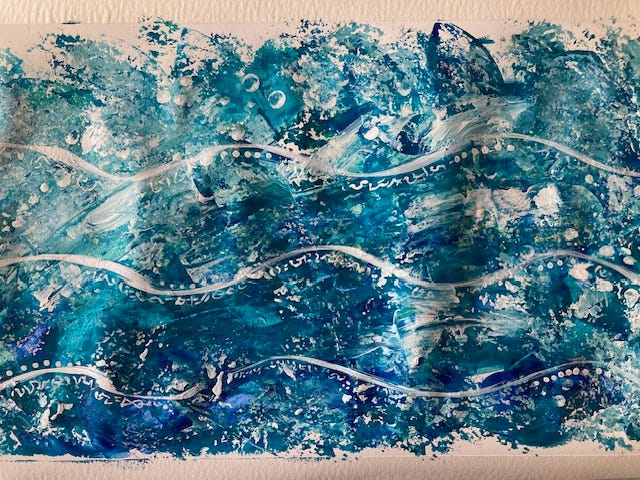
So then, I painted. Turbulence in the water. Grief in motion. Gave it form, gave it color, gave it somewhere to go. Intentional creativity in action — not making something pretty, but making something true.
That’s how grief moved through me this week. Not by my shuffling away or returning to center and moving on, but by returning to center — and then deepening. To what was actually asking for attention. Witnessing it. Giving it form. Letting it transform.
Yes, stuff happens. The question is whether we shuffle past it or deepen into it.
Deepening is one way home.
If you’re new here and this feels like your kind of place — welcome. Stay a while.
If someone came to mind while you read this, send it their way.
This essay is compelling because it smoothly transitions from the philosophical question of the phone call to the tangible, physical experience of the body. Its progression—from heart-energy congestion to awakening with an old wound, and finally to painting 'turbulence in the water'—illustrates what authentic, intentional creativity entails. It’s not just about aesthetic refinement; it’s about providing an ancient, unspoken emotion with a physical form where it can be transformed.
Such a potent and heartfelt inquiry. Thank you.